



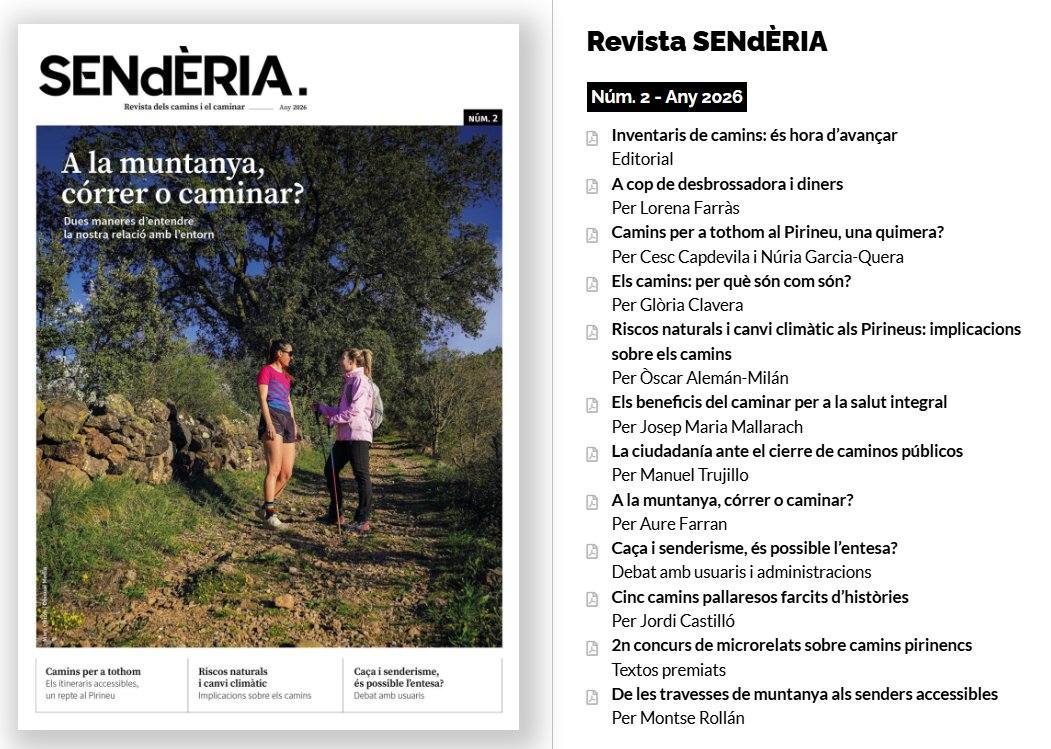
The new issue of Sendèria magazine is now available, a reference publication focused on mountain paths and walking in the Pyrenees. This issue brings together valuable contributions that combine technical knowledge, field experience, and territorial reflection.
In this issue, I have contributed with the article:
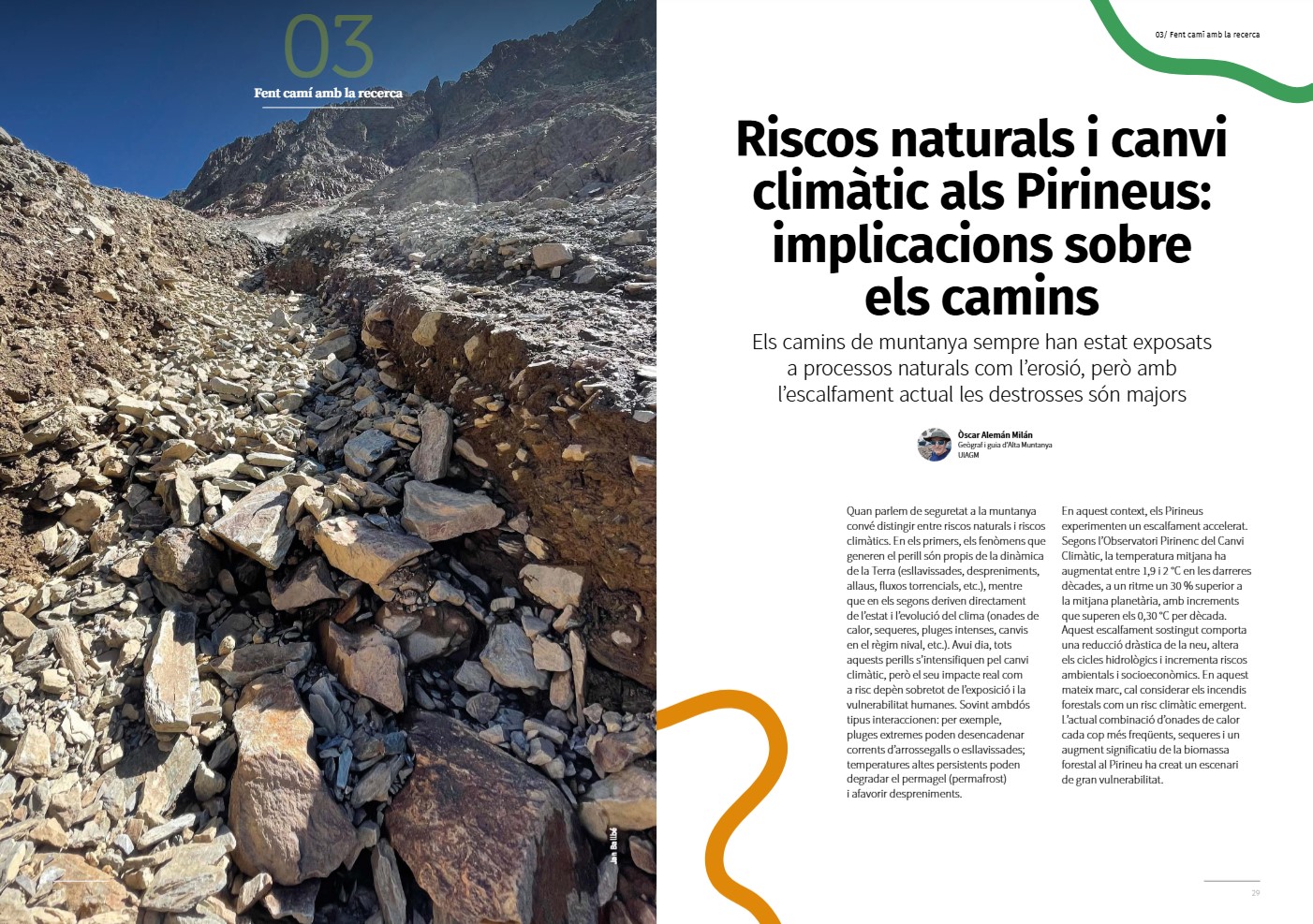
“Natural hazards and climate change in the Pyrenees: implications for trail networks”, where I aim to provide a perspective from physical geography and mountain dynamics on an increasingly relevant issue for territorial management.
The magazine was presented last Friday during the افتتاحion of the Camin_Art hiking festival in El Pont de Suert, a privileged setting to share knowledge while experiencing the Pyrenean landscape firsthand.
I would also like to highlight the excellent work of IDAPA and the Taula de Camins de l’Alt Pirineu i Aran in transferring knowledge about this topic. Initiatives such as this magazine are key to connecting research, management, and the responsible use of the territory.
You can read the magazine here:
https://sompirineu.cat/senderia/
And access the full article (PDF):
https://sompirineu.cat/senderia/wp-content/uploads/2026/05/RevistaSENdERIA_num2_03b_CanviClimatic.pdf
Abstract
Mountain trails constitute territorial infrastructures that are closely linked to the geomorphological and climatic dynamics of the environments in which they are embedded. In the current context of climate change, the Pyrenees are experiencing shifts in the frequency, intensity, and spatial distribution of various natural processes, including extreme precipitation events, slope movements, snow dynamics, and snow and ice melt in high mountain environments.
This study analyses the implications of these changes for trail networks, highlighting an increase in their structural and functional vulnerability. Many routes, originally established under different historical climatic conditions, now show mismatches with current active processes. This results in a higher incidence of damage, temporary loss of connectivity, and increasing maintenance requirements.
Based on this diagnosis, the study argues for the need to incorporate an adaptive perspective into trail management, grounded in the understanding of geomorphological processes, the systematic monitoring of vulnerable sections, and the integration of risk into territorial planning. It concludes that adapting trail networks is not only a matter of safety and functionality, but also an opportunity to move towards more resilient management models, better aligned with the dynamic nature of mountain systems.
